

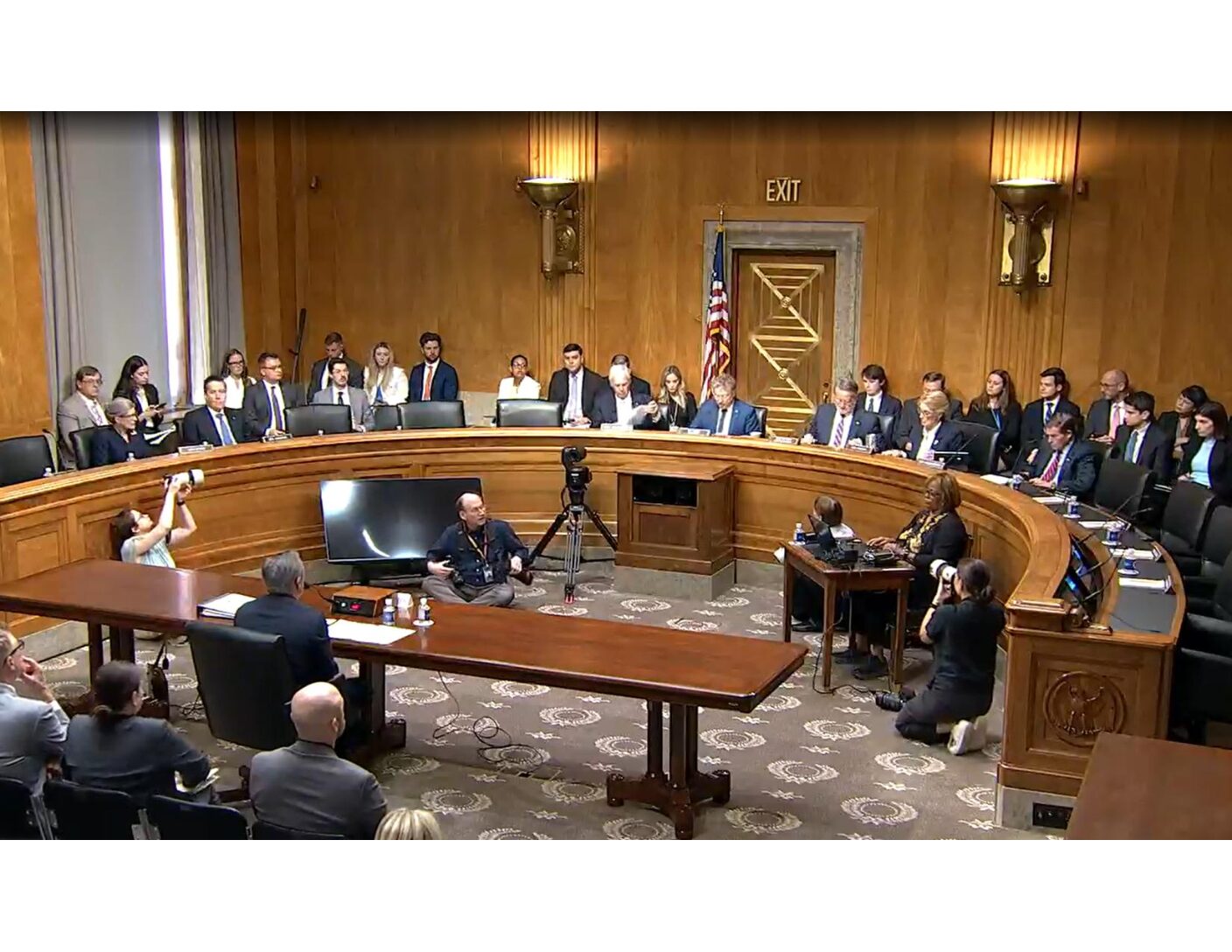
After the House Subcommittee on Government Operations heard from the Postal Regulatory Commission on June 4, and the Senate Homeland and Governmental Affairs reviewed two nominees to be governors of the Postal Service on June 17, the postal trifecta was completed when Postmaster General David Steiner appeared before the Senate committee on June 24.
Statements
Neither the PMG’s opening remarks nor his 33-page prepared statement contained anything new. Produced with the careful editing of postal publicists and lawyers, it reprised familiar themes about regulation, uncontrollable costs, the universal service obligation, the need for added funding, etc. The statements clearly demonstrated the PMG staying on his message.
Sen Rand Paul (KY). In his opening statement, the committee chair recited a litany of USPS failures and promises for change that never materialized. He stated that before Congress would again offer financial relief for the agency, the Postal Service must provide (1) “a real plan to bring labor costs under control”; (2) “proof that private partners will be used where they cost less”; (3) “a commitment to stop capital spending that shows no return”; (4) “a willingness to consolidate facilities than no longer make sense”; and (5) “proof that service mandates can be met without permanent losses and, if it cannot, an honest debate bout the mandate itself.”
The chairman also urged greater use of contractors, arguing that they were less expensive and an alternative to expanding the more costly career postal workforce, something former PMG Louis DeJoy did when he insourced functions in operations and transportation. Ultimately, Paul asked the PMG to guarantee he would send a “more detailed analysis of what you can do [and] what you can’t do because the gist of what I got from you today is the need to borrow more money.” While he advocated for a hiring freeze, he only belatedly noted that what he meant by “hiring freeze” may not be the same as what the PMG said was recently announced.
Sen Gary Peters (MI). In his opening comments, the Ranking Member took up the proposed rule about mailed ballots that was issued in compliance with an Executive Order, asking the PMG “Under what legal authority can the Postal Service regulate who and how people can vote by mail”? Similar questions came from others on the committee, all of whom sought the drag the PMG into the political fray.
To that question and two many more the PMG deferred to the courts, or focused only on that portion of the proposed rule about the design of election and ballot mail. Steiner never stated that the proposal was not initiated by the USPS but produced simply to comply with the president’s order. The repeated absence of such a clarification became noticeable, but the reasons for it were left to the surmise of observers.
Q&A
The more interesting part of such a hearing is when the committee members have their time to make statements and ask questions. Not surprisingly, the senators often used their time for comments on current partisan issues before turning to the PMG to ask prepared questions typically designed to bait the witness into providing the desired response. Sometimes, the PMG was asked questions that either suggest the poser did not have a complete grasp of postal basics or was simply testing the PMG’s knowledge. For example, during his time, Senator Paul asked how rates go up.
Sen. Ron Johnson (WI). He stated that he sees two problems: “operational problems and unfunded liability problems.” He asked what the PMG would do to make the Postal Service “solvent operationally,” i.e., without the mandates. He also asked about the USPS retirement plan – something the PMG could not answer.
When Johnson asked about “vanity” ZIP Codes, i.e., those requested by local jurisdictions for purposes other than mail distribution, Steiner offered an explanation of questionable accuracy. First, he said that changing a digit on a ZIP Code required a facility to receive that new sortation, then added that a new ZIP Code requires a new sort bin at every facility in the country, resulting in a total cost of $800 million.
Looking at the results of prior reform actions, Steiner claimed they addressed the “accounting” issues but not the “operational” issues, citing six-day delivery as an example.
Sen. Margaret Hassan (NH). She opened with a discussion of the proposed rule about ballots, then moved to asking about projections of the Postal Service’s financial condition and what specific steps the PMG has taken that would influence the trajectory.
Steiner offered an explanation of the steps in mailflow and stated that he’s looking at savings opportunities at each, but he added he wanted to be very clear that “we are out of cash” and that “we could not pay all of our bills today.”
Sen. James Lankford (OK). He observed that in recent months there has been “increasing expenses but decreasing speed of service,” compared to private companies that are increasing speed. Steiner attributed the problem to visibility, claiming that mail gets “shoved to the end of the line” and that greater visibility would solve that. Lankford also raised the issue of ZIP Codes not differentiating between jurisdictions. Steiner repeated his assertion that a new ZIP Code costs $800 million and requires adding a new separation at all facilities.
Sen. Andy Kim (NJ). He started with the issue of USPS carriers serving as census enumerators, and was particularly concerned because Steiner was not aware of pilot tests conducted several years ago. That evolved into criticism that Steiner was not aware of the federal statutes applicable to sharing census data, and a question about how statutory problems encountered in the earlier pilot aren’t an issue in the current pilot. Kim also wanted assurances that the PMG would seek resolution of safety issues at the Trenton (NJ) P&DC.
Sen. Rick Scott (FL). His initial comment was that he didn’t understand “how businesses lose money.” He then asked Steiner “if there were no limitations, what would you do”? The PMG responded by reporting that the USPS had engaged “the pre-eminent restructuring firm in the world,” but that the costs for labor will need to be reduced, in turn decreasing service and closing “a massive number of post offices.”
Scott also asked why the revenue per piece for Marketing Mail was less than that for First-Class Mail. Steiner attributed that to the “antiquated pricing structure that is imposed on us by the PRC,” not on the fundamental differences between the classes. Then Scott asked “what’s the PRC”? Steiner explained the initials, but Scott asked “so who’s that”? Steiner said the PRC was set up in 1971 to oversee the monopoly, but added “there’s zero chance that we’re a monopoly at this point.” “It seems we have a regulatory body that is regulating in a past era,” referring to an earlier comment by Sen. Paul that the PRC should be eliminated and the governors of the USPS be allowed to perform its functions
Steiner asserted that the PRC’s limitation on rate increases to once per year cost the USPS $700 million, which he said was transferred to postal customers, but Scott replied that it was actually transferred to taxpayers [apparently a separate population]. Scott again asked why the PRC was “in existence,” and Steiner repeated that it’s supposedly because “we are a monopoly.”
The conversation returned to why a First-Class letter cost more than, as Scott stated, “the marketing mail I don’t want to read.” Steiner replied that “you wouldn’t believe how arcane those pricing rules are.”
Sen. Elissa Slotkin (MI). She raised a question about the lack of funds for rural services while the government is funding conflict, then moved onto the proposed ballot rule, making assertions of political purposes. She asked Steiner whether it’s his obligation to deliver mail to the address shown, then asked why the USPS would adopt a rule that might inhibit voting by mail. Referring to Seiner as a “pawn” in the matter, he noted it was still a proposal but conflated (as Slotkin noticed) the voter list and mailpiece design aspects of the proposed rule. “Please push back,” she asked.
Sen. Joni Ernst (IA). She began with what seemed to be a reference to Regional Transportation Optimization, but mischaracterized it as having a 15-mile limit (rather than 50) and affecting delivery (rather than collections). She claimed that the 10-Year Plan “left a lot of rural Americans behind,” citing a PRC opinion that “recommended that the Postal Service reconsider [the Plan] because so many communities will experience a downgrading of service standards.”
In turn, she asked what Steiner was doing “to protect” service to rural constituents. Stating it wasn’t just a rural problem, Steiner stated that “We have not been as good as we should be in delivering to all of America.” He added that the hub-and-spoke logistics network “makes total sense,” but that “the problem is that we didn’t learn how to operate that system as we were building it.” He added that “what you’ve seen over the last 18 months” is “pretty dramatic increases in our service” because “we’re actually starting to understand how to manage the network effectively.” He further claimed that the “tail of the mail” and late-arriving mail was not a network issue but a visibility issue.
She also raised ZIP Code concerns, complaining that Urbandale (IA) has too many ZIP Codes that don’t align with jurisdictional boundaries and has lead to “misdirected mail.”
Perhaps her most intriguing comment was that she had a bill to require political committee mailings be paid “at a regular rate” rather than at a reduced rate for which they may now qualify.
Sen. Ruben Gallego (AZ). His opening issue was the post office in San Luis (AZ), apparently a non-delivery office where residents are provided a post office box. Gallego claimed the town had grown to over 35,000 residents and that persons trying to access the post office (on the town’s main street) are blocked by morning and evening transborder traffic backups. Gallego claimed he’s been working to add delivery to the town, but Steiner responded that he needs to cut costs as delivery stops increase nationwide. Gallego still asked the PMG to visit San Luis to see first hand the situation citizens have ben dealing with for years.
Sen. Bernie Moreno (OH). After initially indicating interest in whatever plan the PMG would submit, Moreno then launched into a partisan rant about elections and ballot mail, refuting other partisan comments offered earlier. Why this was being delivered to the PMG wasn’t clear. Returning to postal matters, Moreno asked the PMG’s opinion of the Postal Service’s role in combating scams, but he transitioned this to a question about “unsolicited ballots.”
Sen. Josh Hawley (MO). Hawley was as prepared for the issues he wanted to discuss as the PMG apparently was not. First, he showed a poster-size picture of mail than had been dumped on April 29 in St. Louis, linking it to reports of lost mail, and complaining that he’s heard nothing from the USPS about the matter.
After saying he would be outraged, he said he was unaware of the incident. Steiner had walked into a buzzsaw; Hawley noted he and others in Missouri’s Congressional delegation had written to him about the incident as well as lost and delayed mail, but Steiner repeated that it was the first time he’d heard about it.
Then Hawley produced a chart of service scores in the Missouri-Kansas district, noting that the FY 25 score was only 76.2%, and asking the PMG if that was “acceptable.” Steiner said it was not, but offered that the “numbers have been increasing.” Not deterred, Hawley noted that his request to the USPS OIG to audit the St Louis P&DC resulted in the OIG reported saying “it was the worst case of the lack of on-time delivery, the worst case of distribution problems he’d ever seen.”
Steiner tried to advise Hawley to look on-line to see improved service scores, but that only stoked Hawley further. Noting he hasn’t been able to get any answers from the PMG and his staff, Hawley then produced a chart of the bonuses paid to PMGs – $305,781 in 2025 and over $2 million over the past ten years. “Why are you getting bonuses when my constituents can’t get the mail?” Hawley asked. Steiner tried to explain that the Board of Governors decides on bonuses, but Hawley asked if Steiner would “pledge not to take them.” As Steiner equivocated, Hawley pressed harder, saying that “we’ve got a big problem and based on what I’ve seen today you’re part of it.”
Sen. Paul commented that the committee wants a response within a week about the dumped mail, to which Steiner said he could probably get back to them “within an hour.” Paul also asked if the report of the restructuring firm advising the USPS would be shared with the committee; Steiner assured it would be.
Paul also repeated his contention that the USPS could never be efficient, and that in turn required outsourcing to private companies who are motivated to be efficient. He also urged a “hiring freeze” and a review of six-day delivery.
Interesting was how firmly Paul advised Steiner “to aggressively do the opposite of what DeJoy was doing” that he has “to reverse everything that DeJoy did. DeJoy messed it up and made it worse … it was already broken and he rebroke it and scrambled it into a thousand pieces … everything he was doing was making the post office lose more money.”
Sen. Richard Blumenthal (CT), arriving late, asked if the committee has questions about the USPS or postal services whether Steiner would commit to responding “within a timely period.” “Absolutely,” the PMG replied. Blumenthal then asked about the Executive Order about election mail, going over matters already covered with other members of the panel. When asked if he supports the proposed rule, Steiner diverted the discussion to only that portion that involved mailpiece design, and avoided any direct responses about whether he would deliver a ballot as addressed.
By the end of the two-hour hearing, it was unclear whether it would yield any benefit for the Postal Service.
There was the usual partisan sniping across the panel, and predicable questions to the PMG about his agency’s role under the recent Executive Order. The PMG’s request for financial relief got uneven attention, but significant pushback about what he was doing to control costs. The senators’ comments and questions clearly fell along party lines.
Some senators appeared to have not read their briefing books while others – like Hawley – were very prepared. Steiner himself had been primed to answer in accordance with the Postal Service’s stated positions, but fared poorly with questions about other matters on which he should have been better briefed by staff, but wasn’t.