

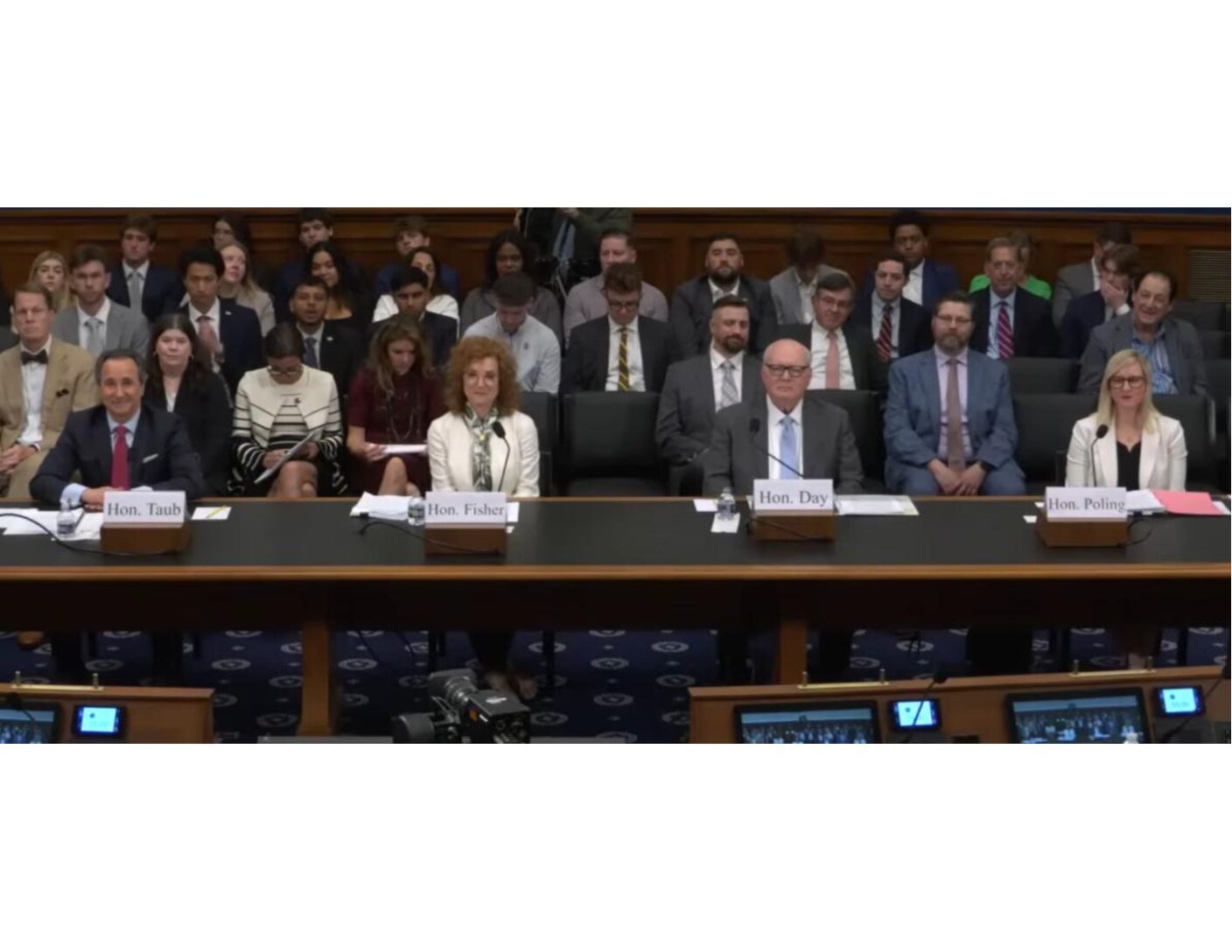
On June 4, the four current members of the Postal Regulatory Commission testified before the House Subcommittee on Government Operations. Though the hearing was captioned simply as a hearing with the commissioners, its primary purpose was to learn their perspective on the state of the Postal Service and related issues.
In both their written testimony and responses to questions from the subcommittee members, the commissioners did not disappoint, each offering straightforward and consistent opinions based on their observations of the USPS.
Chairman Taub
By far the most extensive comments were by acting chairman Robert Taub. In summarizing his over 70 pages of testimony and supplemental appendices, Taub stated, in part:
“Almost 3 months ago, the Postmaster General of the United States testified before you and presented a dismal future of the Postal Service, stating that it would run out of cash and stop delivering mail within 12 months. He also presented three ‘doors’ from which Congress could choose a solution. Two doors leading to continued dismal results and the quickened demise of the Postal Service (e.g., stopping mail delivery, severely reducing service, closing Post Offices, and raising prices), and one he referred to as the ‘Goldilocks Choice’ which he championed would be ‘just right’ and solve all of the problems – which can generally be described as give us more money.
“The ‘Goldilocks Choice’ is not the panacea for the Postal Service’s ills. The proposal includes increasing its borrowing cap and reallocating Civil Service Retirement System (CSRS) liabilities to support investments and universal service. It proposes reforms to diversify retirement funds and challenges current actuarial assumptions to reduce pension payments. Finally, the Postal Service advocates for Federal Employee’s Compensation Act (FECA) reforms to apply private-sector best practices, projecting significant savings. Unfortunately, none of these remedies get to the crux of the Postal Service’s financial situation: fixing the fundamental funding structure of the Postal Service while preserving appropriate service and delivery standards by defining the Universal Service Obligation (USO) America expects of its Postal Service.
“… The Commission cautions against adopting the Postmaster General’s approach of just granting the Postal Service the freedom to operate like a ‘truly independent entity’ and ridding it of any regulatory or statutory requirements and hoping that will make everything better. This approach combined with the ‘Goldilocks Choice’ can generally be described as give us more money with less oversight. The Postal Service is not an independent entity; it is a government entity with two statutory monopolies over letter delivery and mailbox access that no other private sector company or truly independent entity enjoys. This is why Congress established specific (and limited) statutory and regulatory guardrails, and the Commission has implemented over the past 56 years, to protect consumers and businesses from potential monopolistic abuse, such as predatory pricing, poor service, and unfair competition.
“The Commission also cautions against endorsing the Postmaster General’s plan to move full steam ahead with the Delivering for America (DFA) Plan—a plan which promised break-even operations by FY 2023 and a cumulative 10-year net income of $0.2 billion. In fact, in year 6 of the 10-year DFA Plan, the Postal Service has incurred $31 billion in losses and is on a path to lose even more in the remaining 4 years of its implementation. It is a plan that promised to streamline and make more efficient the delivery of mail and parcels and save the Postal Service $28 to $40 billion, as initially estimated, yet implementation of the plan has consistently slowed mail delivery across the United States, specifically in rural areas, which to a greater extent rely on affordable and reliable mail delivery. And the mounting financial losses continue, a situation the Commission warned about on several prior occasions.
“The Postmaster General also suggested raising the $15 billion in borrowing authority of the Postal Service, which was last adjusted in 1992. … Whether to adjust the Postal Service’s statutory borrowing authority is ultimately a policy judgment for Congress, however, the Commission is doubtful that ‘just $15 billion more’ is going to solve the problem. Extend the date of the ultimate crisis, yes; but prevent it, no.
“… The Commission believes that clearly defining the USO is the most important step Congress can take to ensure that the Postal Service can continue to serve the nation. And that is one issue both parties agree on – and is supported by the US Government Accountability Office (GAO) – which also testified along with the Postmaster General in March: Define the Universal Service Obligation for our US Postal Service. In short, the USO, which dictates postal services for the nation, should be defined.
“Defining the USO means describing what the country needs from our Postal Service and setting up a system to fully pay for them. Using the Postmaster’s own words: ‘just tell us what you want us to do and how to pay for it and we’ll do it.’ It really is just that simple.
“Defining the USO involves answering tough questions, but in doing so it also, and perhaps more importantly, forms the basis for the infrastructure and financial arrangements needed to support a self-funded Postal Service for the next 250 years. …
“The Commission has experience setting the parameters of the USO. In 2006, Congress asked the Commission to provide a comprehensive report on universal service and the postal monopolies. In 2008, the Commission presented its report and identified seven specific attributes that make up universal service. I think it’s important to name them here: (1) geographic scope; (2) range of products; (3) access to services and facilities; (4) delivery frequency; (5) affordable and uniform pricing; (6) service quality; and (7) an enforcement mechanism. The first four of these attributes directly impact the costs the Postal Service incurs. The fifth attribute directly impacts the revenue of the Postal Service and the sixth attribute addresses service performance. By defining the USO, Congress would clarify the Postal Service’s public service mission by addressing the acceptable level of postal service – and how to pay for it. To date, however, other than mandating 6-day a week delivery, Congress has not defined the USO.
“Once the duties of the Postal Service under the USO are defined, the costs for providing them can be assigned, and a viable financial structure can be established to support the level of universal service required. …”
The commissioners
Taub’s comments were supported by the statements of the other commissioners.
- Commissioner Ashley Poling observed that
“… As the Vice Chairman’s testimony makes perfectly clear, the situation facing the Postal Service is a 5-alarm fire. Volume of traditional mail continues to decline, a result of both ongoing electronic diversion and an acceleration due in-part to the Postal Service’s aggressive pricing strategy.
“And service quality continues to suffer as the leadership of the Postal Service has decided to slow service standards for several mail products over the last 5 years, including twice for the flagship First-Class Mail product, while also lowering its service performance targets. What this means is simple, the American people are paying more while fewer mail pieces are being delivered in the expected time frame.
“In the Commission’s most recent Advisory Opinion that was issued when the Postal Service further extended service standards by 1 day for First-Class Mail coming from most of the rural areas and small towns in this country, known as the Regional Transportation Optimization initiative, the Commission said something that I strongly agree with, specifically, ‘The Commission agrees that changes are needed to ensure the stability of the Postal Service. However, these changes must not come at the expense of the Postal Service’s core mission: providing prompt, reliable, and efficient mail service to all Americans – regardless of where they live.’ …”
- Commissioner Ann Fisher stated
“… With the 2006 enactment of the Postal Accountability and Enhancement Act, Congress explicitly directed the Commission to establish a Market Dominant ratemaking system designed to achieve a set of interlocking objectives laid out in Section 3622 of Title 39. Particularly relevant for today’s hearing on the Postal Service’s financial crisis is Objective 5: ‘to assure adequate revenues, including retained earnings, to maintain financial stability.’ “True financial stability means a system that can legally generate the capital reserves and retained earnings needed to invest in vehicles, facilities, and modern infrastructure; without long-term financial viability, the universal service mandate cannot be sustained in practice.
“If Objective 5 were the only objective the Commission had to consider, our modeling shows that Market Dominant rates would need to rise by roughly 50 percent to add about 10 billion dollars to annual net income and provide about a 1-billion-dollar buffer for retained earnings. But such an increase would likely trigger an almost 30 percent drop in mail volume – driving away even faster what remaining mail users the Postal Service has. On average, mail volume drops approximately 4.3 percent annually.
“However, that is not how Congress designed the rate system to work. The system Congress created requires Objective 5 to be balanced with 7 other objectives that call for, among other things, maximizing incentives for operational efficiency and cost reduction and maintaining predictable, stable rates and high-quality service standards. The Commission cannot simply allow the Postal Service to ‘price its way’ out of its structural deficit without seriously eroding the very mail volumes that still fund universal service. …
“For the Commission, and for this Committee, to fully assess the Postal Service’s financial position, we must have clear, timely data on the savings, costs, and service impacts associated with major initiatives such as the Delivering for America plan.
“To date, the Postal Service has not provided detailed, verifiable information on the net savings from DFA-related changes, and it is not even clear that the agency itself has this data. That is a serious deficiency. Without knowing what is working and what is not, the Postal Service cannot correct failures or replicate successes. Further, the lack of transparency makes it harder for the regulator, mailers, and Congress to understand whether the current strategy is improving the long-term balance between service, cost, and revenue. …”
- Commissioner Tom Day added
“I am in full agreement with the factual background Vice Chairman Taub’s testimony provides, the summary of performance and the path forward to achieving resolution and improvement. I would like to emphasize a few points, however.
“I fully agree with the Vice Chairman that we must define the scope of the Universal Service Obligation or USO. It’s important to clarify that this is a complex task that will take time, and likely will require revision of the current legislative framework as well. In the meantime, there are other critical steps that can be taken to improve the Postal Service to reduce cost, improve service and ensure a safe and secure work environment for its employees.
“… That said, continued use of the network created under the Delivering for America plan (DFA) cannot achieve an optimal solution. As indicated in the Advisory Opinion issued by the PRC in January 2025, the DFA plan is fundamentally flawed. There were three key findings: 1. It relies upon defective modeling and ill-prepared implementation. 2. The methodology for estimating cost savings lacks validity. 3. It has a significant, negative impact upon rural communities and certain mail products.
“Despite the Postal Service’s best efforts to improve service and reduce costs, the flaws in the DFA network will by design limit what can realistically be achieved. To be clear, improvement will take place – It simply will not be the best it could be. …”
The leadership of the subcommittee again demonstrated a singularly bipartisan willingness to cooperate on crafting a solution to the issues presented by the commissioners. Of course, getting significant action, such as a legislative definition of the USO, to be supported by the whole committee – let alone the other members of the House and Senate, all with their own political and parochial agendas – is a much larger challenge indeed. Whether the subcommittee will try nonetheless remains to be seen.