

As an organization established to serve commercial mail producers, we’re sometimes asked why we’re concerned about the Postal Service’s Regional Transportation Optimization program, which primarily impacts retail customers.
Our answer is simple: RTO violates the fundamental principle of universal service. By arbitrarily differentiating between those customers within a certain distance from a regional processing and distribution center and those farther away, it establishes an inequality between the two, resulting in some being better served than the rest.
At the same time, it suppresses product differentiation – delaying all mail equally – and causes customers to pay the same prices as others but for distinctly different service.
Please note
Before going farther, it’s important to understand what this position is not meant to state.
First, this is not telling the Postal Service how to run its operations. It’s entirely within the Postal Service’s discretion to determine the configuration of its networks, including how many and where processing centers will be established, and the means and timing of its internal transportation.
Second, this is not an altruistic argument indifferent to financial reality. The difficulty and cost of serving customers is not uniform; some can be served easily while others require exceptional effort – and the relative costs follow accordingly.
Third, this is not a refutation of the Postmaster General’s tenet that any level of service can be provided so long as the beneficiaries are willing to pay for it.
However
On the first point, above, it’s important to note that having the latitude to run its operations does not grace the Postal Service with inherent wisdom in its choices or in how its networks can and should be operated, nor does it make its decisions by definition the best or most prudent that could be made. It’s fully empowered to make bad decisions, and it has demonstrated the ability to do so.
On the second point, postal services are provided nationally, and funded nationally – there are no regional or local rates. The concept of universal service reflects the fundamental principle that all customers are equal, that they collectively underwrite the services that the USPS provides, and each receives, or has access to those services as equally to the rest as feasible. Mail from the inner city is no better or worse than mail from the far reaches of the countryside.
Lastly, all customers pay the applicable postage for the service they expect. Customers in cities do not pay less than those in rural areas; customers of large retail units pay the same as those of tiny post offices; and retail mailers pay the same applicable rates as those who send mail commercially. RTO-impacted customers are not looking for service they don’t want to pay for; on the contrary – they’re not getting the service they are paying for.
Origins
The RTO concept originated under the leadership of former postmaster general Louis DeJoy. Initially tested as Local Transportation Optimization, LTO eliminated the afternoon collection trip to post offices more than fifty miles from the serving RPDC. (How the limit was set at fifty miles, rather than twenty or seventy, has never been explained.)
Regardless, its advertised purpose was threefold, as best it’s been explained to us: 1) to reduce transportation cost; 2) to maximize vehicle utilization (e.g., to fill trucks); and 3) to enable processing facilities – the RPDCs – to begin dispatches earlier than would be possible if processing had to wait for collections from distant post offices. This ability was promoted as yielding better service.
At the same time, in addition to halving the contracted transportation to outlying facilities (i.e., those fifty miles or more from the RPDC), transportation services within the fifty-mile circle would be insourced to postal employees driving USPS vehicles, thus allegedly lowering costs even more.
The attraction of the plan was obvious: eliminating afternoon service would save money, fill trucks, and allow earlier conclusion of evening processing operations. DeJoy was confident that RTO served the purposes of his 10-Year Plan. Unfortunately, no-one in his inner circle spoke up to ask whether the assumptions were correct or, more importantly, to defend the interests of those customers impacted adversely by the reduced service that RTO provided.
Results
Since RTO has been implemented, the USPS has assumed that it has saved the cost of canceled transportation contracts, but there’s been little evidence provided publicly that savings were measured and realized as expected. Similarly, there’s no evidence provided publicly that the total cost of insourced transportation actually was less than that of the contracted transportation it replaced.
At the same time, there’s no explanation for why the Postal Service chose to eliminate all contracted transportation to the “remote” offices rather than simply the “deadhead” contracts that were the most costly. Converting contracts to all “layover” mode still would have saved significant money without having to sacrifice the afternoon collection service to outlying post offices.
Though DeJoy fixated on the notion of full trucks, there’s been no post-implementation study – at least, none made public – to substantiate that RTO improved vehicle utilization. At the same time, there’s been no apparent analysis of how the end of the afternoon runs affected the movement of mail transport equipment, or the added time and difficulty of concurrently loading and unloading mail and MTE on the same truck at the same time when only one trip operates.
What was not considered (or was dismissed) in the run-up to RTO was its impact on service. Mail being entered at an RTO-impacted office after the morning trip leaves sits until the next morning trip – whether the next day or later if there’s a weekend and/or holiday involved. Obviously, this likewise also delays that mail reaching its destination. Conveniently, however, and indifferent to how that delay is perceived by the ratepaying customer, the Postal Service simply contrived a way to suspend time so that its service performance scores wouldn’t be adversely affected.
The invention of “Day 0” served the purpose of allowing the USPS to ignore the time mail sat at an RTO office before finally being collected. By omitting the day of tender at an RTO office – and any additional days before the mail reached the RPDC for processing – the calculated service performance for impacted mail would be unchanged.
(Unfortunately for those seeking to differentiate among USPS products, “Day 0” is agnostic to what type of mail is involved or the postage paid to send it: Priority Mail Express and Marketing Mail are all delayed equally.)
Excess
Those who advanced RTO under DeJoy, and those who continue to support it under his successor, persist in abstractly praising its alleged benefits to the Postal Service. The impact of the program on service to the affected customers is brushed aside as a necessary sacrifice (by only them) to improve the economic health of the USPS.
Therein lies the error.
It’s inarguable that the Postal Service needs to reduce all costs, and to examine every reasonable way to do so. However, the pursuit of cost reduction should not be pursued as an end unto itself, indifferent to other obligations, or without balancing it against the related consequences.
Replacing old overhead lighting fixtures in processing plants with more energy-efficient LEDs reduces costs, but turning off the lights entirely would save even more money. The resulting cost reduction would be significant, but made at the expense of the purpose of the lights in the first place.
Service to small post offices – to all post offices – is binary, i.e., either there’s transportation to them or not. As with the lighting example, there are ways to reduce the related costs – like less expensive “layover” contracts. However, eliminating half of the necessary transportation is a cost reduction made at the expense of the purpose of transportation in the first place – to move mail and provide service to ratepayers.
As noted above, this also establishes a sheep-and-goats distinction between two classes of otherwise “similarly situated” customers, i.e., those inside or outside the arbitrary fifty-mile circle. Whether the Postal Service accepts the argument or not, this is unreasonable discrimination among ratepayers that’s being implemented under the sanctifying guise of cost-reduction. The USPS is supposed to meet its universal service obligation by serving all customers equally, even those that may be farther afield than others.
By pursuing RTO, the Postal Service is failing to meet one of the fundamental purposes of its existence.
Scope
Lest readers conclude that the impact of RTO is being exaggerated, we refer to detailed information developed by Save the Post Office earlier in the program’s deployment. As can be seen in the chart below, nearly three quarters of the nation’s post offices lie fifty or more miles from an RPDC, and those post offices serve nearly half of all postal customers.
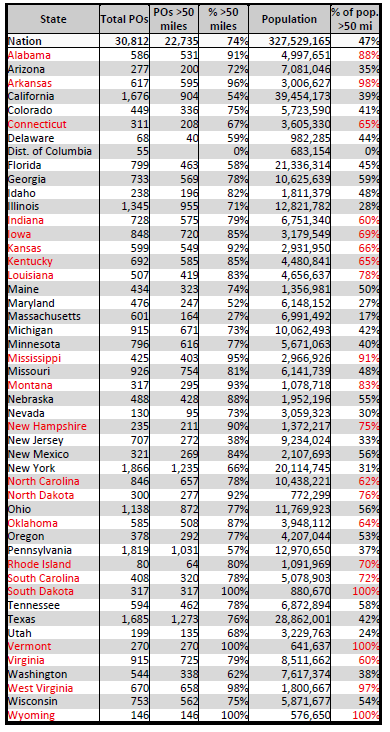
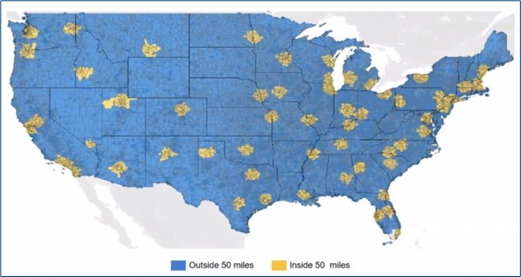
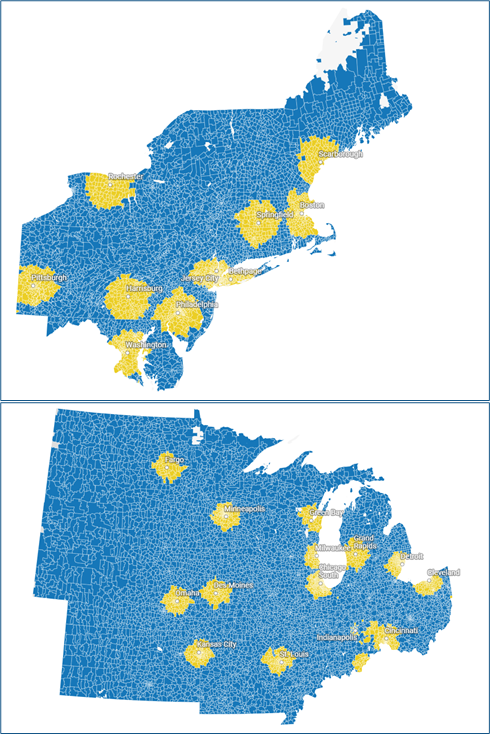
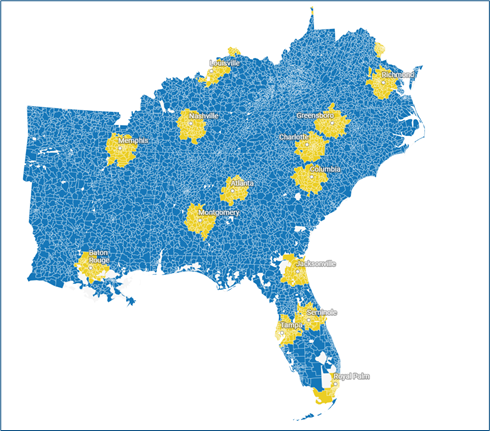
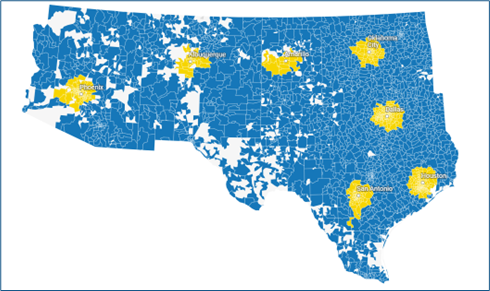
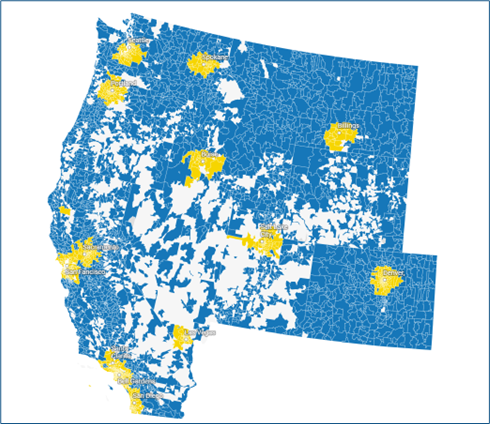
As if to illustrate the inequality of RTO’s impact, it affects the majority of post offices in all but two states and the District of Columbia. Meanwhile, 60% or more of customers in 21 states (in red) are impacted. In three states, South Dakota, Vermont, and Wyoming, all post offices and all customers are adversely impacted by RTO. The map (below) further illustrates how post offices and customers fortunate enough to be in the right location are clustered around the cities where RPDCs are (or are planned to be) sited. (The map is based on where those were at the time and may change accordingly.)
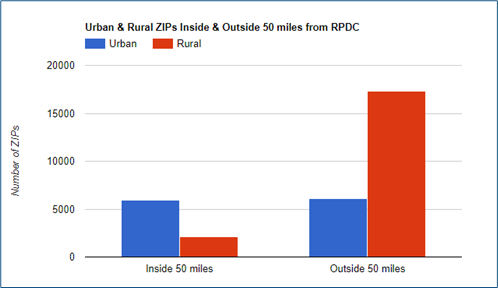
Looking at it from the rural vs urban viewpoint starkly illustrates the unequal impact of RTO ever more clearly. As Save the Post Office noted earlier,
“… about 74% of the ZIPs outside the 50-mile radius are rural while 26% of ZIPs inside the radius are rural. About 90% of all rural ZIPs are outside the 50-mile radius and subject to RTO. Looking at the urban/rural divide in terms of population, the model shows that the country as a whole is about 21% rural. Inside the 50-mile radius the population is 8% rural, while outside it’s 35% rural. Of the country’s rural population as a whole, 20% lives inside the radius while 80% lives outside. …”
The maps below, also by Save the Post Office,illustrate the swaths of impacted post offices (blue) compared to the unimpacted islands around the RPDCs (yellow); non-delivery areas are white.
As stated at the outset, RTO isn’t a concern for commercial mailers or, consequently, for most of the organizations that represent their interests. Accordingly, RTO implementation isn’t a topic that they discuss when meeting with legislators. However, for members of the House committee with postal oversight to understand the impact of Regional Transportation Optimization in their districts, below are some relevant statistics (as of March 1); members of the House Subcommittee on Government Operations are listed in bold.
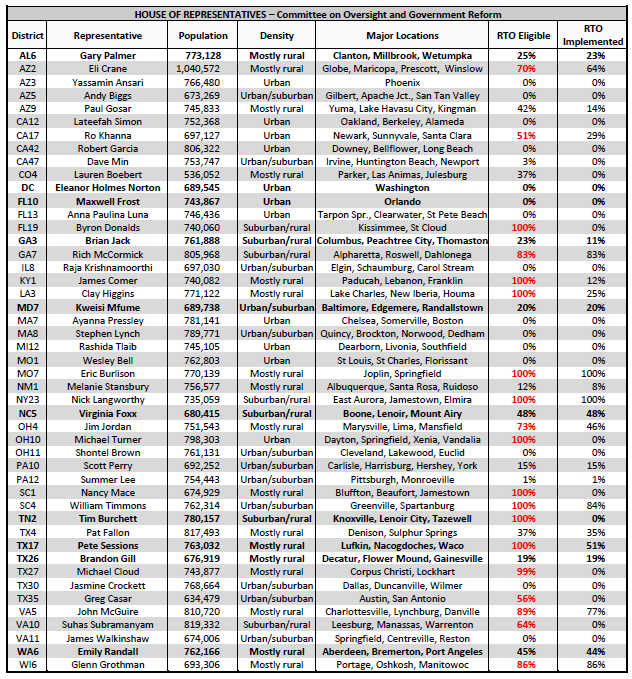
Similar statistics are available for the districts represented by the other members of the House not on the committee, and for the states served by each of the 100 members of the Senate.
To the extent any legislator has been approached by the Postal Service to inform about, or answers questions regarding RTO, we would note that there are two sides to the story. While the USPS will argue that RTO is essential to stabilize the financial condition of the Postal Service, the other side of the story would be that, while cost control is critical, the fundamental purpose of the agency is to provide service. The universal service obligation requires the Postal Service to serve and treat all customers equally, regardless of their proximity to a processing facility, and to provide timely service equally to all types of mail – whether bills, tax returns, or ballots – regardless of whether that mail is deposited at a big city post office or at a rural post office miles from the city. The discrimination among customers and their mail represented by RTO is not justifiable simply as cost control; it’s fundamentally inconsistent with the Postal Service’s mission.