

In an order issued without fanfare on October 7, the Postal Regulatory Commission reopened the public inquiry docket (PI2023-4) regarding the Postal Service 10-Year Plan. As the commission explained in its order,
“On April 20, 2023, the Commission initiated this docket to examine network changes associated with the Delivering for America (DFA) strategic plan, finding it beneficial to provide a forum to learn more about planned initiatives that may have a significant impact on the postal community. On November 7, 2025, the Commission closed this docket, explaining that it would continue to monitor DFA initiatives and proactively seek information where appropriate. For the reasons discussed below, the Commission now reopens the docket to examine recent changes associated with the DFA Plan. …”
As the PRC further explained, it found events warrant further review:
“On October 4, 2024, the Postal Service requested an advisory opinion from the Commission regarding two DFA-related initiatives: (1) a nationwide network of RPDCs and LPCs that would consolidate and reduce transportation lanes between facilities; and (2) Regional Transportation Optimization (RTO). The Postal Service claimed that these two initiatives would allow for improvements in mail processing productivity and network efficiency, and it also estimated cost savings in the range of between $3.6 and $3.7 billion once the initiatives are fully implemented.
“In its advisory opinion, the Commission evaluated the projected cost savings estimates and found that they were not supported by sufficiently reliable evidence. … The Commission further noted that the projected cost savings, if realized, represented a modest share, approximately 4.4% of the Postal Service’s total operating expenses in FY 2024 while causing disproportionate harm to service reliability in rural communities.
“On September 18, 2025, the Commission issued an information request in this docket, seeking updated information on DFA facilities (S&DCs, RPDCs, LPCs) and RTO ZIP Codes. In response, the Postal Service stated that the purpose of the docket concluded with the Postal Service’s request for an advisory opinion, urged the Commission to withdraw the CHIR, and recommended the Commission close the docket.
“In Order No. 9343, [issued November 7, 2025] the Commission explained that seeking information to determine whether Commission action was required in this proceeding was not limited to determining whether an advisory opinion was needed. … Rather, the Commission found that ensuring transparency regarding the DFA Plan and its impact on issues such as cost, efficiency, and service performance was the relevant inquiry. However, noting that the information requested could be obtained through upcoming Postal Service reports, the Commission granted the Postal Service’s Motion and closed the docket on November 7, 2025. …
“Since the Commission closed this docket on November 7, 2025, the Postal Service has continued to implement operational changes to its network. Some of the changes appear to be planned or modified DFA initiatives while others appear to be new initiatives altogether. The Commission is again concerned about the lack of information regarding the current status of the DFA strategic plan, and the Commission is also concerned that the ongoing operational changes continue to negatively impact costs and service performance.
“Recent media reports show on-going declines in service performance and operational efficiency in areas where DFA initiatives are being implemented. …”
The commission’s order included an example of how The Plan is hurting service:
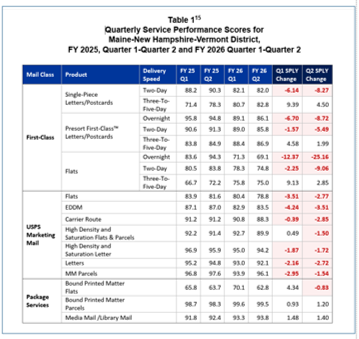
“For instance, in FY 2026 Quarter 1 and Quarter 2, the Postal Service implemented RTO at 83.9% of planned 5-Digit Zip Codes in the Maine-New Hampshire-Vermont district. The Postal Service plans to have only one RPDC in this district. As shown in Table 1 below, service performance declined for 11 out of the 18 measured Market Dominant product categories in FY 2026 Quarter 1, compared to the same period last year (SPLY). In FY 2026 Quarter 2, the number of product categories for which service performance declined increased to 13 product categories.”
“The observed declines in service performance cause additional concerns that DFA initiatives may have contributed to reduced operational efficiency within the district. Currently, the Commission does not have the information and data required to determine the causes of these service performance issues observed in these areas, or whether the causes are related to transportation or processing changes due to RTO implementation, RPDC activations, or any other new DFA initiatives.
“It also appears that recently, certain DFA initiatives have been notably modified. For example, the Postal Service has expanded the role of some RDPCs to include standalone Regional Transfer Hubs (RTHs). A USPS Office of Inspector General (OIG) report on RTHs stated that as of March 2025, the Postal Service activated 18 facilities with RTH operations located throughout the country, and 3 of the 18 facilities (Denver, CO, Dallas, TX, and Phoenix, AZ) performed only RTH operations, while the others were co-located with existing processing facilities. The most recent Section 207 report shows that the purpose and function of RTHs differs now from the description provided in Docket No. N2024-1. In its update to the description of the modernized network, the Postal Service lists RTHs as operations or facilities, while previously it listed RPDCs, LPCs, and S&DCs only but did not include RTHs. This change suggests that RTHs play a different and more significant role than the Postal Service previously described. …
“Finally, the Commission has observed other network changes, but it is unclear whether these changes are related to the DFA Plan. For example, the Postal Service has recently terminated a number of contract postal units (CPUs). In the FY 2025 Annual Compliance Determination Report, the Commission found that between FY 2024 and FY 2025, the total number of retail facilities decreased by 406, but the largest decrease was in the number of CPUs, which decreased by 244.18 It is not clear if these CPU closures are related to the DFA Plan, and it is also unclear what impact the CPU closures may have on cost and service.”
After listing the many sources of concern about what the USPS is saying or doing, the commission reached an understandable conclusion:
“These examples highlight the need for better transparency related to the DFA Plan as it moves into its seventh year and as the Postal Service continues to face financial and service challenges. A USPS OIG report concluded that although the Postal Service has made some strides in implementing DFA Plan initiatives, further action remains outstanding and the path ahead is unclear. In addition, a recent US Government Accountability Office (GAO) report explained that DFA cost-cutting initiatives had led to declines in service and highlighted the importance of clear communication from the Postal Service about its ongoing and planned actions to address persistent concerns about service performance. …
“Accordingly, this docket will be reopened to seek information regarding certain changes related to the DFA Plan. As before, the Commission intends to issue information requests to learn about proposed changes to the network as well as the possible impact of recent changes on costs, service, or certain customers
“Interested parties may also propose questions by filing motions seeking information requests following the procedures listed at 39 CFR part 3010.170(e). …”
It’s certain that the Postal Service’s senior leadership did not welcome the docket’s resurrection. In any venue where they can be heard publicly, postal executives complain about the lack of operational flexibility represented by the PRC’s oversight and – in their view – meddling in how it should be allowed to run the USPS as it sees fit.
What’s equally certain is that those executives will not reflect on how the agency has operated and performed since Louis DeJoy implemented his 10-Year Plan. They will not consider how the inconsistencies between what was stated and what was done undermine credibility, nor how the lack of transparency engenders distrust.
Above all, there will be no consideration that the myopically insular and self-centered approach taken to implement The Plan – without regard to its impact on ratepayers and the service they deserve – may be a primary reason for the audits, investigations, and inquiries.
In this situation, the USPS has caused its own problems but, if history is a guide, it will blame others and keeping doing business as usual.