

The Postal Service’s quarterly financial and service performance numbers likely won’t be published until mid-December, but odds are they’ll be accompanied by carefully crafted pronouncements asserting that the 10-Year Plan is still working just fine.
That there will be a significant financial loss – again – will be explained away as caused by uncontrollable factors that would be remedied if Congress would just give the USPS all the legislative relief it’s seeking. Fortunately for the Postal Service’s publicists, Congressional inaction, despite legislators’ griping, will offer plenty of evidence for the agency’s continued inability to turn around its financial circumstances.
Service
Any bases on which to question the financial data are far fewer that those that will be available when service performance is reported.
Any upticks in service scores will be highlighted but the likely majority of scores that remain below service targets won’t be. Here, too, there will be predictable excuses about facility construction, contractor issues, and bad weather, accompanied by assurances that service is always improving. Increasingly, the Postal Service is claiming A-level performance even when the numbers show it’s actually a C.
For example, over the past 19 quarters, starting in Postal Quarter I of Fiscal Year 2022, the Postal Service has missed 56 of 95 (58.9%) of its quarterly national targets for First-Class Mail, 32 of 57 (56.1%) for Marketing Mail, and 14 of 19 (73.7%) for Periodicals.
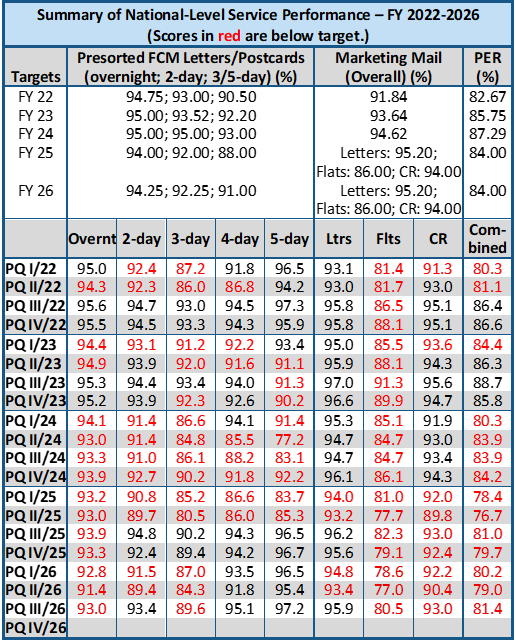
Notably, its national score for Marketing Mail flats has never hit the applicable target. “Bundle breakage” is the Postal Service’s canned explanation for that, as it is for Periodicals.
Moving the goalposts
The agency’s primary tools to evaluate service performance are the service standards and targets it sets and the method it uses to measure achievement of them. Looking at that arrangement doesn’t require a rocket scientist to immediately doubt the objectivity of the process or the validity of the figures that are reported. It’s essentially grading your own test.
Over the almost five-year period, scores have risen and fallen, sometimes seasonally, but the background for all of them is the Postal Service’s annual rejiggering of the targets.
For example, the agency sets targets for First-Class Mail (overnight, 2-day, and 3-to-5-day) and, over the five years, it has retained any of them to the next year only once. Targets for Marketing Mail and Periodicals were repeated only from FY 2025 to FY 2026.
Moreover, the targets have not been getting more demanding despite other operational and measurement changes that should have enabled significant numeric improvement. For example, the FY 2026 targets for overnight, 2-, and 3-to-5-day First-Class Mail are 94.25%, 92.25%, and 91.0%, respectively, compared to 94.75%, 93.0%, and 90.5% in FY 2022. Not exactly raising the bar.
More important, regardless of the numerical target or score, is how it’s calculated, and that’s been becoming more lenient over time. Since inception of The Plan, the Postal Service has repeatedly lowered its service standards, created exceptions and exclusions to measurement, redefined “start-the-clock,” and simply skipped counting some days altogether.
As a result, the elapsed time that it takes for ratepayers’ mail to move from “A” to “B” is typically longer than the time claimed by the Postal Service. In other words, if a five-day standard applies, and it takes eight days in elapsed time from deposit to delivery, but only five by the agency’s calculations, it can claim it met its target.
Performance-defined success
Perhaps the most obvious example of the Postal Service defining its own success was in a September 25 Industry Alert titled “Adjustments to Priority Mail and USPS Ground Advantage Service Expectations for Noncontiguous States and Territories.”
Though it concerned a very small portion of overall volume, it still contained a revealing statement of its purpose: “alignment of service expectations with actual performance.” In other words, the USPS is making current performance the target, not setting a target and striving to achieve it.
By doing so, albeit for a small proportion of volume, the Postal Service has taken another step in its self-serving process of transforming what customers should expect from quality service into no more than whatever it actually does. If it’s too hard – or not “efficient” – to provide service deserving more than a “C,” the Postal Service’s apparent solution is to simply redefine whatever it does provide as an “A.”