

The practice of regime change – one way or another – has gained a certain popularity of late. Usually the initial change is replacement of the person at the top, followed by a winnowing of those in subordinate positions until holdovers from the prior regime have left – one way or another.
Fortunately, the US had an orderly process for regime change, electing a president every four years. That person then selects individuals to fill a long list of administration positions, almost always displacing the previous occupants.
The USPS
For the Postal Service, there is no election of a postmaster general; rather, the PMG is appointed by the Governors of the Postal Service and serves at their pleasure. With one exception, those who have held the position since 1970 (when the USPS was established) have left on their own terms. In most cases the incoming selectee – in the pattern of other new leaders elsewhere – chooses who will be the key executives in the organization, charged with implementing the policies set by the governors and the PMG.
From 1998 through 2020, four postmasters general were persons who rose through the ranks, knew the USPS thoroughly, and had both a cadre of top executives and a “deep bench” of others preparing to move up in the organization.
When Megan Brennan left in 2020, however, the governors’ choice – Louis DeJoy – had no postal background but within months not only claimed to know all that was wrong with the Postal Service but issued a Plan for how to fix it. He also demoted, reassigned, or forced out many of the senior leaders who were in place when he arrived. In their stead, DeJoy brought in former private sector colleagues or elevated headquarters executives who would be true to his Plan.
After less than five years, DeJoy’s Plan wasn’t producing promised results, and his abrasive style left him with no friends to fend off the growing chorus of critics. Reportedly at the urging of the governors, DeJoy left somewhat abruptly in March 2025. His replacement, David Steiner, was sworn in the following July 14.
New regime or not
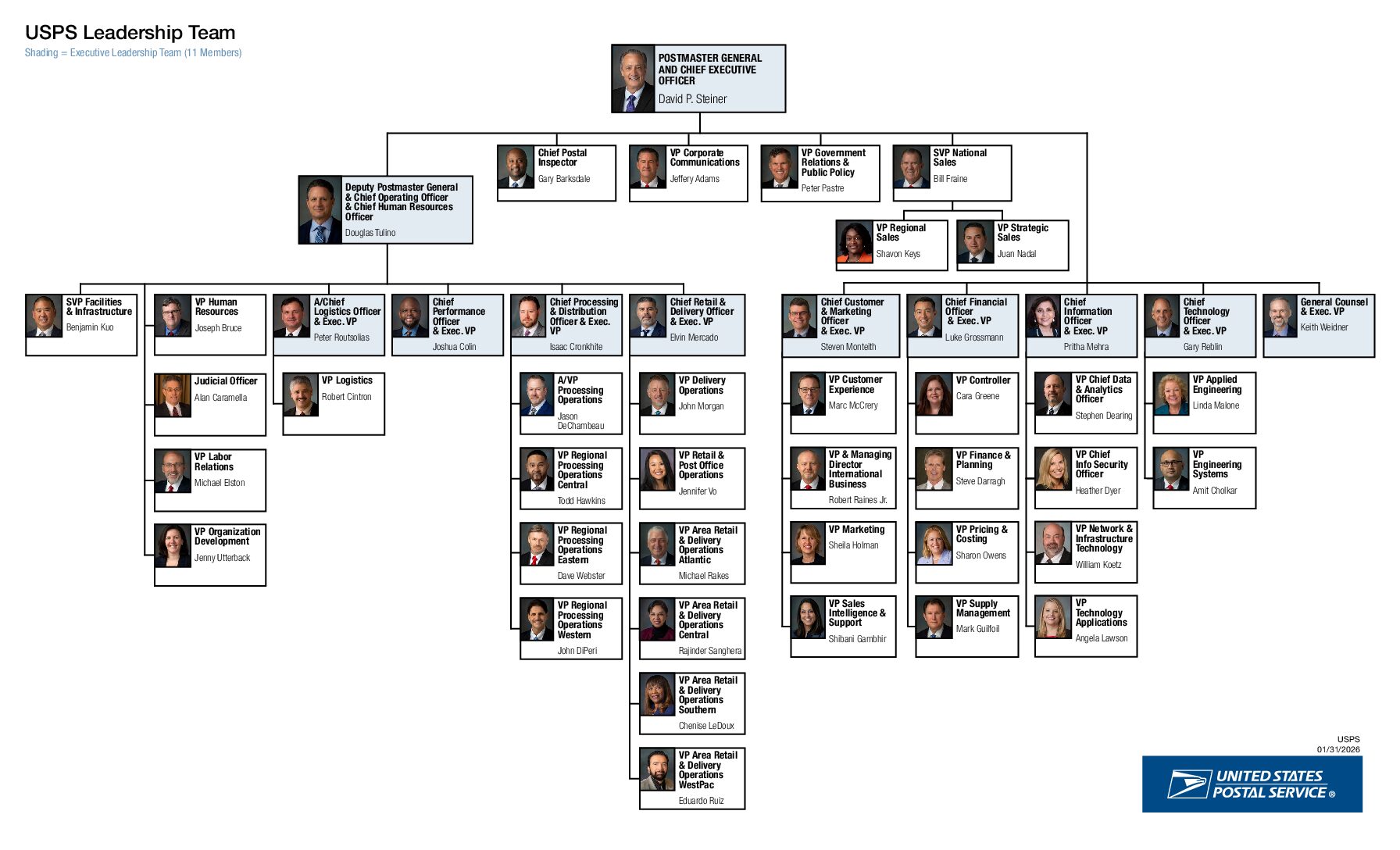
What’s been unusual about the latest postmaster general – aside from a pleasantly less adversarial attitude – is that he’s retained the senior leadership chosen by his predecessor. Many observers had anticipated – even looked forward to – a housecleaning that would bring in persons not tied to DeJoy and his Plan. So far, that hasn’t happened, but it’s becoming clear that it has to happen – sooner rather than later.
In some ways, however, it may already be too late.
When Steiner arrived, he began to assess the condition of the institution he was chosen to lead. First from the governors (who had supported DeJoy) and later from senior executives, he undoubtedly was told about the Postal Service’s problems, and who and what caused them, and that what was being done (under DeJoy’s Plan) would fix them. He also heard about the mailing industry, how it opposes change for parochial reasons, how industry leaders don’t support measures being taken to implement The Plan, and how they refuse to accept the higher prices necessary to bolster postal finances. In effect, he’s been getting indoctrinated by the true believers in the DeJoy Plan since the day he was hired.
Over the past eight months, it’s unknow whether, and to what degree, Steiner has sought differing views. He’s met with a handful of industry executives, and visited a few association meetings, but how much these have altered his thinking is unclear.
When speaking at the quarterly meetings of the Mailers Technical Advisory Committee, his high-level comments have indicated continued support for The Plan, and many of the initiatives started under DeJoy continue to be implemented. If Steiner was hired by a board that wanted him to perpetuate what DeJoy started, he seems to be fulfilling that mandate. However, given weak revenue, shrinking volume, persistent costs, and declining service, the question is whether Steiner should still believe The Plan is how to proceed.
Of course, doing otherwise has two challenges. First is whether Steiner has his own independent alternatives and the confidence to convince the governors to let him change course. Second, even if he wanted to diverge from The Plan, DeJoy’s acolytes who are still in place may offer resistance, or undermine any change of direction.
Spring cleaning
For Steiner to escape DeJoy’s shadow, there are some actions he needs to take on his own initiative.
First, he has to seek and learn from knowledgeable people with perspectives that don’t align with The Plan. Congress will eventually grill him about issues that have been brought to its attention, and he needs to present his own ideas – not recitations from The Plan – about what he will do. DeJoy aggravated many in Congress, so it wouldn’t be prudent for Steiner to favor continuing what DeJoy started.
Second, he needs to look for internal talent and develop it. There are still executives from the pre-DeJoy days who’ve assembled a line of worthy successors, but that’s not true for all functional areas – particularly the most critical.
Third, he needs to make changes within the leadership of those functions that are not demonstrating success. Despite cutting transportation, investing heavily in facility renovations, lowering service standards, changing service measurement, and reducing service to outlying post offices, there’s been no documented proof of promised savings while service has worsened quarter after quarter.
Finally, he has to review the DeJoy policy of a “stable workforce,” especially when labor negotiations lie ahead. Many executives would favor a flexible workforce than can be adjusted to variable mail volume, which wouldn’t be the 534,000 expensive fixed-schedule employees he inherited. Decades of unchanged labor agreements can’t be undone all at once, but fresh thinking is needed to start the process of reducing labor costs.
Spring is on its way, and it may be time for Steiner to finish the regime change by doing a little spring cleaning of the headquarters org chart.