

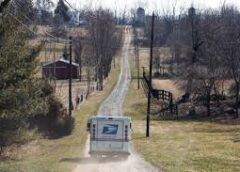
In an example of what’s-old-is-new-again, the Postal Service announced on December 17 that it will be taking bids from shippers who want the agency to provide last-mile delivery. Details of the program will be disclosed “in the coming months,” with winning bidders being selected “in the second calendar quarter” of 2026 and service beginning the quarter after that, i.e., in June 2026.
Postmaster General David Steiner, quoted extensively in the announcement, early in his still brief tenure realized the value of the Postal Service’s “ubiquitous” delivery network and has sought to monetize it as a source of much-needed revenue. Getting companies now doing their own delivery to instead give their shipments to the USPS – who will be going by those same addresses anyway – seemed to be logical.
New?
As the announcement noted, any such arrangements would be under a negotiated service agreement, hundreds of which are already in place. All NSAs define the terms of service – e.g., volume, preparation, and places of entry – and, under existing rules, all NSAs are first reviewed and approved by the Postal Regulatory Commission to ensure prices yield adequate cost coverage. Therefore, how an NSA initiated by a bid would differ from a conventional NSA is unclear.
Moreover, any business can already bring items to its local post office for local delivery and simply pay postage.
As a result, under either scenario above as well as under the bid process, the obvious calculations by any potential shipper would be largely the same. Would using the USPS for last-mile delivery (1) be less costly than a competitor or doing its own delivery; (2) be simply easier than running its own delivery operation; and (3) provide equal or better service?
Point 1 is based on numbers, and point 2 is subjective based on the effort the shipper wants to invest, but point 3 is where the USPS is most vulnerable.
Though the PMG claimed that the USPS has “achieved impeccable service performance scores for our last mile,” observers know that the agency’s reported scores benefit from a variety of ameliorative exceptions and calculation methods, and so may not accurately reflect real experience.
Economics
Though the PMG should be credited for trying to win new package business for the Postal Service, it’s uncertain how dispassionately he’s been advised about the potential for the planned bid process.
First, those businesses who would participate are already either doing their own delivery or, more likely, using a postal competitor. Therefore, as part of the simple three-part assessment noted above, a shipper will measure the bid (cost of using the USPS) against what UPS or FedEX, for example, would charge. In the end, if the USPS is selected, the margin (revenue in excess of cost) the agency will get may be smaller than it would like, or than it’s assumed would be generated by the added business.
Second, proponents of the bid process – whether internal staff or consultants – may not have accurately assessed the response of shipping competitors. As private companies, UPS and FedEx have more operational flexibility and greater control over personnel costs than does the Postal Service. If they choose to respond with additional price reductions for shippers considering a last-mile bid with the Postal Service, new business for the USPS may not be realized as expected.
Lastly, whatever business the USPS wins may not be as beneficial as projected. Aside from how competitors may fight the USPS on price, they also know those places where they find delivery unprofitable – such as in rural areas. In the past, UPS solved that by the SurePost agreement with the Postal Service under which it used the USPS for last-mile delivery. Other potential bidders might consider bidding with the Postal Service as their own, similar solution. As a result, whatever additional package volume the USPS might get could be in those places where, as competitors found, it’s most costly to provide service.
In practical terms, more volume to rural areas could translate into the need for larger facilities, for more or larger vehicles, and for more people to process and deliver the shipments.
Whether the USPS has adequately considered these possible consequences is unknown but, regardless, the possible net improvement in revenue may not be as great as the Postal Service’s executives have anticipated or as its public optimism would suggest.
Amazon
Of course, as was explained in the previous issue of Mailers Hub News, Amazon wants to finalize its own NSA with the Postal Service to continue using the agency for last-mile delivery. If it can’t do so, it’s prepared to build out its own network to insource delivery.
Reportedly, one obstruction to getting the deal done is the Postal Service’s now public plan to make shippers bid to access its last-mile capacity. Should the USPS not accommodate Amazon’s wish to be treated differently – it’s not just another shipper – the agency could lose an estimated $6 billion in annual revenue from the company – not exactly the bottom-line impact the bid program was supposed to yield.
By early 2026, we should know more about the details of the bid process, how it will work, and what the Postal Service expects it will provide – as well as whether Amazon will still be a postal customer.